


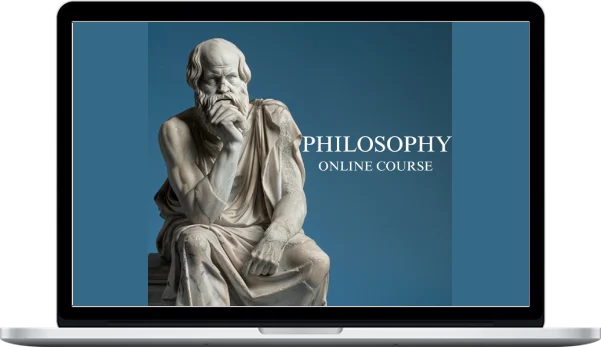
Danilo Drumond – Online Philosophy Course
How Will This Course Help You?
- Proven Method
Starting from the very basics, this course allows you to gradually build and deepen your knowledge. - Greater Understanding
By learning the ideas that shaped the world, you’ll gain clarity about your own place in it. - Deeper Connections
With philosophical knowledge, you become more engaging — using empathy and logic to form deeper, more meaningful relationships. - Arsenal of Ideas
Studying philosophy is like “leaving the cave” to explore the universe of ideas. Through these classes, you will acquire unparalleled cultural enrichment. - Intellectual Autonomy
Develop critical thinking and defend your ideas with clarity and confidence.
THE JOURNEY TO A CLEARER, MORE BALANCED, AND MORE MEANINGFUL LIFE STARTS HERE.
What Is The Online Philosophy Course?
With this course, you’ll explore the minds and wisdom of over 300 great thinkers across 2,600 years of history.
It’s never been easier or more accessible to dive into the ideas of the world’s greatest minds — all explained in a clear and straightforward way.
Here, you’ll gain access to the people who shaped the very ideas that define the world we live in today.
What are the benefits of accessing the minds of theses Great Philosophers, right now?
- DEEPER KNOWLEDGE
You’ll gain a profound and comprehensive understanding of philosophy — from the most basic principles to complex, contemporary theories. It’s your chance to build solid, well-founded knowledge that covers the full journey of human thought. - PERSONAL AND INTELLECTUAL GROWTH
You’ll notice real changes in your personal and intellectual development — including how you think, reflect, and build a foundation of knowledge that helps you grow. - PRACTICAL APPLICATION
Apply philosophical insights to everyday life. This book brings clarity to existential questions and offers a new understanding of the world and the human mind.
This Course Is For You If:
- You want to better understand the world and the human mind
- You want to make smarter decisions
- You are seeking personal and intellectual growth
- You want to become more knowledgeable and well-informed
- You are looking to achieve a state of mental clarity and peace
What Will You Learn?
CHAPTER 1: INTRODUCTION
- What is philosophy ⬝ Philosophical problems and answers ⬝ What is philosophy for ⬝ Mythological thinking ⬝ Ancient Greece
CHAPTER 2: Pre-Socratics
- Thales of Miletus ⬝ Pythagoras ⬝ Heraclitus and Parmenides ⬝ The pluralists ⬝ Leucipo and Democritus
CHAPTER 3: SOCRATES
- The strengthening of democracy ⬝ The sophists: Protagoras and Gorgias ⬝ The life of Socrates
CHAPTER 4: PLATO
- The World of Ideas ⬝ The Demiurge ⬝ The Second Navigation ⬝ The Myth of the Cave ⬝ Dialectics ⬝ The Soul and the Body ⬝ Politics, Art, and Religion
CHAPTER 5: Aristóteles
- The Degrees and Division of Knowledge ⬝ Logic ⬝ Metaphysics ⬝ The First Mover and Aristotelian Physics ⬝ Ethics ⬝ Politics ⬝ Art
CHAPTER 6: HELLENISM
- Cynicism: Antisthenes and Diogenes ⬝ Epicurus ⬝ Skepticism ⬝ Stoicism: Zeno, Seneca, Epictetus, and Marcus Aurelius ⬝ Plotinus and Neoplatonism
CHAPTER 7: Patristics
- Philo ⬝ Jesus Christ and Christianity ⬝ The Early Christian Philosophers ⬝ Augustine of Hippo ⬝ Pseudo-Dionysius ⬝ Severinus Boethius
CHAPTER 8: Scholasticism
- Scotus and Anselm ⬝ The Arabs ⬝ Thomas Aquinas ⬝ Meister Eckhart ⬝ Bacon and Ockham ⬝ Marsilius of Padua ⬝ John Wycliffe and Jan Hus
CHAPTER 9: Renaissance
- De Cusa to Mirandola ⬝ Erasmus and More ⬝ Machiavelli ⬝ Luther and Calvin ⬝ Montaigne ⬝ Giordano Bruno and Galileo Galilei ⬝ Francis Bacon
CHAPTER 10: Modern Philosophy
- Hobbes ⬝ Descartes ⬝ Pascal ⬝ John Locke ⬝ Spinoza ⬝ Malebranche and Occasionalism ⬝ Isaac Newton ⬝ Leibniz ⬝ Vico ⬝ Bernard Mandeville ⬝ Berkeley
CHAPTER 11: Enlightenment
- Enlightenment ⬝ Montesquieu ⬝ Voltaire ⬝ Thomas Reid ⬝ David Hume ⬝ Rousseau ⬝ Adam Smith
CHAPTER 12: German Idealism
- Immanuel Kant ⬝ Lessing ⬝ The Transition to the 19th Century ⬝ Jacobi ⬝ Fichte and Schelling ⬝ G. W. F. Hegel
CHAPTER 13: Contemporary Ideas
- American Transcendentalism: Emerson and Thoreau ⬝ Auguste Comte ⬝ Spencer ⬝ The Utilitarianism of Jeremy Bentham and John Stuart Mill
CHAPTER 14: Marxism and Anarchism
- Feuerbach ⬝ Saint-Simon ⬝ Charles Fourier ⬝ Etienne Cabet ⬝ Max Stirner, Proudhon, and Bakunin ⬝ Engels ⬝ Karl Marx
CHAPTER 15: Critical Philosophers
- Arthur Schopenhauer ⬝ Friedrich Nietzsche ⬝ Freud ⬝ Henri Bergson ⬝ Oswald Spengler
CHAPTER 16: Frankfurt and Pragmatism
- The Frankfurt School ⬝ Walter Benjamin ⬝ Horkheimer ⬝ Adorno ⬝ Marcuse ⬝ Erich Fromm ⬝ Habermas ⬝ Peirce, James, Dewey, and Rorty
CHAPTER 17: Phenomenology and Existentialism
- Husserl ⬝ Heidegger ⬝ Hannah Arendt ⬝ Kierkegaard ⬝ Jaspers ⬝ Viktor Frankl ⬝ Sartre ⬝ Beauvoir ⬝ Lévinas and Mounier ⬝ Merleau-Ponty ⬝ Camus
CHAPTER 18: Analytic Philosophy
- Analytic Philosophy (Boole, Frege) ⬝ G. E. Moore ⬝ Bertrand Russell ⬝ Wittgenstein ⬝ Vienna Circle
CHAPTER 19: Science and Language
- Karl Popper ⬝ Thomas Kuhn ⬝ Paul Feyerabend ⬝ Gaston Bachelard ⬝ Hilary Putnam ⬝ Herder and Quine ⬝ Schleiermacher and Gadamer
CHAPTER 20: Contemporary Politics
- Ortega y Gasset ⬝ Hans Jonas and Arne Naess ⬝ Ayn Rand and Objectivism ⬝ Michael Novak ⬝ Robert Nozick ⬝ John Rawls ⬝ Nancy Fraser
CHAPTER 21: Contemporary Religion
- William Paley ⬝ Bultmann ⬝ John Hick ⬝ Anthony Flew ⬝ Richard Swinburne ⬝ Richard Dawkins ⬝ André Comte-Sponville
CHAPTER 22: Contemporary Society
- Lyotard ⬝ Michel Foucault ⬝ Peter Singer ⬝ Byung-Chul Han
Who Is The Teacher?
Danilo Drumond has a clear mission: to show that learning philosophy can be both simple and transformative. Everyone should have access to this knowledge to better explore and enjoy life.
His interest in philosophy began in childhood, when he spent time at a public library diving into books on religion and anthropology. Later, he earned degrees in both Philosophy and Journalism, solidifying his passion for critical thinking and the pursuit of knowledge.
As he began his career as a teacher, Danilo faced the challenge of explaining complex philosophical concepts to young people and adults who had not completed high school. Determined to make philosophy accessible, he invested in countless courses, read hundreds of books, and completed two additional postgraduate degrees.
In the classroom, Danilo quickly saw how engaged his students were when discussing big philosophical questions. That enthusiasm inspired the creation of this book — which originally began as a podcast and soon gained wide attention. As his audience grew, Danilo decided to turn his years of experience and accumulated knowledge into a complete, clear, and accessible course for everyone.
More courses from the same author: Danilo Drumond
Related products