

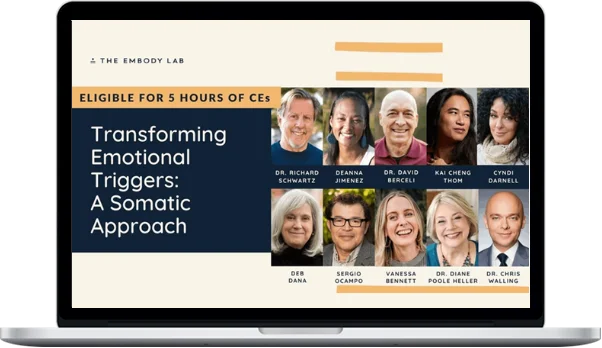
Richard Schwartz – Transforming Emotional Triggers: A Somatic Approach
“Transforming Emotional Triggers: A Somatic Approach,” offers a deep dive into understanding and working with emotional triggers through a body-centered lens. It thoroughly explains how triggers are hardwired in the nervous system and manifest as physiological and psychological events, leading to overwhelming experiences. The curriculum integrates mindfulness-based cognitive therapy (MBCT) with various somatic tools, such as vagal regulation techniques, breathwork, and sensory grounding, to help individuals cultivate embodied self-awareness and expand their window of tolerance for distress.
Ultimately, this package empowers both individuals and practitioners to reframe triggers as entry points for profound healing, fostering new pathways of safety, presence, and choice-based responses to transform life-limiting patterns.
About the Program
Emotional triggers can derail therapy sessions, sabotage client progress, and leave both practitioners and clients feeling helpless in the face of overwhelming reactivity. But what if triggers aren’t obstacles to avoid—but portals to healing?
This groundbreaking course, created by Dr. Scott Lyons and the Embody Lab, transforms how practitioners understand and work with emotional triggers through a comprehensive somatic lens.
A Paradigm Shift:
Triggers are not just psychological events—they are rapid, automatic physiological sequences hardwired into the nervous system as neural networks from past overwhelming experiences. These bodily responses often arrive before conscious awareness, flooding both body and mind in ways that feel life-limiting and uncontrollable. Understanding this deep embodiment is the key to transformation.
What You’ll Learn In Transforming Emotional Triggers: A Somatic Approach
Through expert teaching, demonstrations, and experiential practices, you’ll discover how to:
Understanding the Physiology:
- Recognize triggers as hardwired neural networks with distinct physiological markers
- Track rapid shifts in musculature, fascia, organs, and autonomic functions
- Identify how positive feedback loops create overwhelming emotional flooding
- Understand somatic responses as primary signals that precede conscious awareness
- Distinguish between safe and threatening stimuli when the body overcorrects
Somatic Interventions and Tools:
- Apply vagal regulation techniques including diaphragmatic breath and box breathing
- Use self-supportive cranial contact and targeted diaphragm work
- Guide body scan meditations and sensory tracking practices
- Implement broad orienting and grounding techniques like the butterfly hug
- Practice extended breathwork to expand the window of tolerance
- Support clients in completing unmobilized protective responses
Mindfulness and Cognitive Integration:
- Understand Mindfulness-Based Cognitive Therapy (MBCT) for trigger management
- Work with rumination, catastrophizing, and the window of resilience
- Cultivate present-moment awareness to create choice-based responses
- Connect thoughts, emotions, and physiological responses
Parts Work and Inner Child Healing:
- Map the trigger zone to identify unique bodily sensations, emotions, and thoughts
- Meet the protector and observe external behavioral responses
- Complete the cycle by allowing the body to express protective actions
- Tenderly embrace the inner child through embodied protector work
- Transform relationships with triggers through four-stage somatic inquiry
Reframing and Empowerment:
- Shift language from “triggered” to “awakened” or “activated” for client empowerment
- View triggers as entry points to implicit memories and unresolved wounds
- Recognize triggers as containing wisdom and keys to healing
- Apply the Window of Transformation framework
- Navigate between containment and exploratory approaches
- Access triggers as portals to pleasure, connection, and aliveness
Building Resilience:
- Develop an emotionally intelligent lifestyle across physical, mental, emotional, and spiritual domains
- Create proactive resourcing practices for trigger prevention
- Improve heart rate variability through consistent regulation practices
- Balance energy expenditure and renewal activities
- Expand capacity through titrated embodied exploration
Polyvagal Understanding:
- Track movement through dorsal (freeze), sympathetic (fight/flight), and ventral (social engagement) states
- Cultivate fluid movement toward ventral vagal for thriving relationships
- Use polyvagal theory as a framework for transforming emotional responses
Essential training for therapists, coaches, and healing professionals ready to help clients transform overwhelming reactivity into opportunities for profound healing and expanded aliveness.
More courses from the same author: Richard Schwartz
Related products